

Once considered the gray market, Ontario has turned into one of the most attractive regulated iGaming markets in the North American region. Shifting away from a government-run monopoly, Ontario became the first Canadian province to open the regulated online gambling market to private operators on April 4, 2022. Since then, the small province has transformed into one of the industry’s most talked-about success stories for regulated gambling in Canada.
The framework is overseen by the Alcohol and Gaming Commission of Ontario (AGCO), the province’s gambling regulator established in 1998, while iGaming Ontario is responsible for managing commercial relationships with private operators. Businesses must register with the AGCO and enter into an operating agreement with iGaming Ontario before starting to offer services to the public, with Ontario’s regulated market now growing to 49 operators across 84 gaming websites.
The experiment became successful when, in the 2024-25 fiscal year, regulated operators generated CAD 82.7 billion (~USD 59.08 billion) in wagers and CAD 3.2 billion (~USD 2.29 billion) in gaming revenue, reaching an all-time high and surpassing all previous years’ records. What’s more, according to the latest annual study, 83.7% of Ontario players reported gambling on regulated sites, demonstrating that licensed platforms captured a clear majority of activity despite the continued presence of unregulated alternatives. In contrast, across Canada, the offshore market remains dominant at USD 5.6 billion, 1.75x higher compared with a domestic market valued at USD 3.9 billion.
In fact, the Ontario gambling license offers established operators an opportunity to enter a part of the world’s third-largest iGaming market, where regulation has already demonstrated its ability to attract a massive share of players away from unregulated alternatives, making local authorization essential to remain competitive and trusted by Ontario consumers.
An operator holding this license is authorized to operate online casino games, sports and event betting, esports, fantasy sports, betting exchange products, peer-to-peer poker, and peer-to-peer bingo. It must also execute an iGO operating agreement before launch.
This category generally covers businesses that manufacture or develop gaming equipment, games, or critical gaming systems.
This category covers suppliers of gaming equipment or services that are directly related to playing a lottery scheme or operating a gaming site, such as platform providers, wallet technology providers, odds makers, game-system operators, and registered independent testing laboratories.
Demand for an Ontario gaming license continues to rise as more operators seek to secure a credible regulatory presence in Canada early, before more provinces follow suit and introduce their own licensing regimes to bring the offshore era to an end. Accordingly, an Ontario gambling license serves as a regulated gateway to a market with considerable growth potential and a number of additional advantages for operators.
|
|
Tobique
|
Ontario
|
Curaçao
|
Anjouan
|
|---|---|---|---|---|
|
Scope of activities
|
All gaming verticals
|
Casino, sports and event betting, esports, fantasy sports, betting exchange, peer-to-peer poker, and bingo
|
Online casinos, sports betting, lottery, bingo, and eSports
|
All gaming verticals
|
|
Cost
|
EUR 36,000 license fees for the 1st year + technical compliance (only EUR 18,000 license fees for the 2nd year + technical compliance)
|
CAD 100,000 (operators) or CAD 15,000 (suppliers) in government fees alone
|
around EUR 55,000 in license fees only
|
EUR 22,000-30,000 depending on the components
|
|
Time to obtain
|
4 to 10 weeks
|
6 to 9 months
|
4 to 6 months
|
4 to 8 weeks
|
|
Regulation
|
Tobique Gaming Commission
|
Alcohol and Gaming Commission of Ontario (AGCO) and iGaming Ontario (iGO)
|
Curaçao Gaming Control Board
|
Anjouan Offshore Authority
|
|
Reputation
|
Emerging
|
Fast-rising, the first successful Canadian regulated province
|
Established
|
Developing
|
|
Taxation
|
No additional gaming taxes
|
iGO retains 20% of gaming revenue; Canadian federal and Ontario corporate tax may apply according to structure and nexus
|
1% GGR tax, no corporate income tax, VAT, or capital gains tax
|
No additional gaming taxes
|
Entering Ontario’s regulated iGaming market requires paying more than just a single licensing fee. The real cost of an Ontario gaming license is built from several layers: regulatory fees, revenue sharing, taxation, professional legal services, technical certification, and other expenses needed not only to launch but also to remain operational.
The total cost of securing an Ontario gaming license can be divided into several key components:
Please note that Section 9 of the Gaming Control Act also permits the AGCO to charge reasonable investigation costs where additional work is required.
In practice, the Ontario gaming license cost should therefore be assessed as the cost of entering and maintaining a regulated operation in a mature jurisdiction, not an offshore option. For a complete cost estimate based on the specifics of the project, contact Inteliumlaw here to receive up-to-date pricing details.
Few expected Ontario to become such a prominent iGaming market, especially given a historically strong offshore gambling sector in the province. Although offshore operators continue to play a significant role across the wider Canadian market, Ontario has successfully brought the large majority of players within its regulated iGaming framework, now boasting its own gaming license.
As Ontario works to bring more gambling activity within the regulated domain, interest from operators in obtaining the gambling license is naturally booming, along with questions around the complexity of market entry.
Inteliumlaw has outlined the essential AGCO and iGaming Ontario requirements operators must address before they can legally operate in Ontario’s regulated iGaming market.
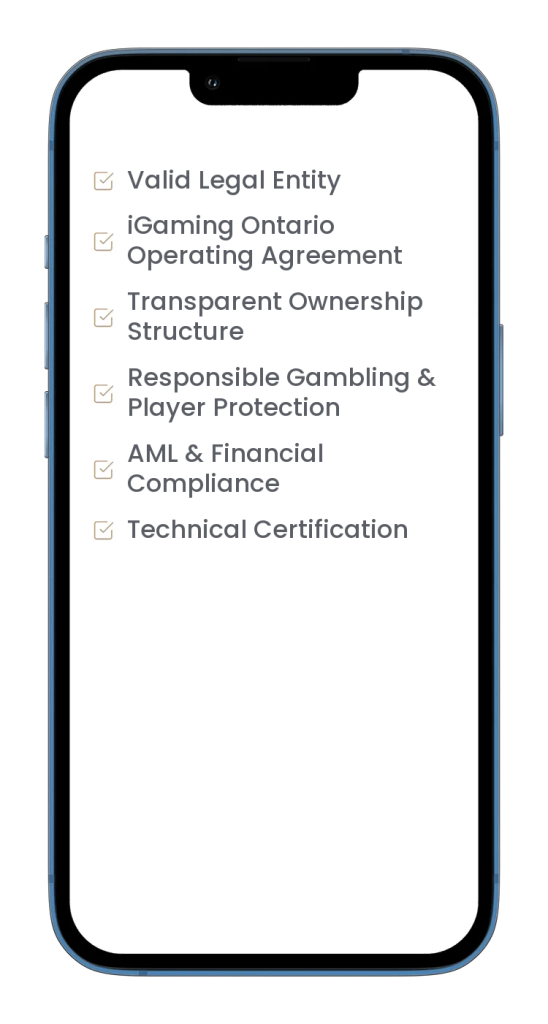
A Canadian or Ontario company registration is optional and not mandatory to apply for a gambling license. Yet, the applicant must be a legal entity (most typically, a limited liability company or LLC) capable of entering the operating agreement with iGO, opening corporate bank accounts, and meeting the applicable regulatory requirements.
An operator must execute an operating agreement with iGaming Ontario covering commercial terms, revenue sharing, and other performance and operational obligations. AGCO registration alone doesn’t grant the right to lawfully serve local players.
As any reputable regulator, the AGCO assesses the suitability of applicants and relevant individuals involved in their ownership and management. Namely, the AGCO's Operator Application Guide requires disclosure capable of tracing relevant interests, including 5% or greater holdings, requiring applicants to provide a clear ownership chart as part of the registration process.
All Ontario gaming license holders managing player communication shall implement robust responsible gambling and player protection measures, including 19+ access, identity and location checks, breaks in play, self-exclusion mechanisms, and compliant advertising. Moreover, iGO requires operators to join BetGuard (launched on May 14, 2026) and obtain RG Check accreditation within two years of the operating agreement.
Applicants must complete AML and financial information submissions and demonstrate appropriate controls under Section 5(k.1) of the Proceeds of Crime (Money Laundering) and Terrorist Financing Act, capturing provincial online lottery schemes. Operators shall implement iGO's centralized AML and anti-terrorist-financing framework, including KYC, monitoring, escalation, recordkeeping, and data-sharing for FINTRAC reports. Onboarding also includes bank due diligence, funds-flow testing, and performance security.
Games and critical gaming systems must be certified by an AGCO-registered independent testing laboratory. The operator must implement control activities against the current Registrar's Standards, complete systems and data readiness testing, and provide the required technology compliance confirmation before going live.
A Canadian or Ontario company registration is optional and not mandatory to apply for a gambling license. Yet, the applicant must be a legal entity (most typically, a limited liability company or LLC) capable of entering the operating agreement with iGO, opening corporate bank accounts, and meeting the applicable regulatory requirements.
An operator must execute an operating agreement with iGaming Ontario covering commercial terms, revenue sharing, and other performance and operational obligations. AGCO registration alone doesn’t grant the right to lawfully serve local players.
As any reputable regulator, the AGCO assesses the suitability of applicants and relevant individuals involved in their ownership and management. Namely, the AGCO’s Operator Application Guide requires disclosure capable of tracing relevant interests, including 5% or greater holdings, requiring applicants to provide a clear ownership chart as part of the registration process.
All Ontario gaming license holders managing player communication shall implement robust responsible gambling and player protection measures, including 19+ access, identity and location checks, breaks in play, self-exclusion mechanisms, and compliant advertising. Moreover, iGO requires operators to join BetGuard (launched on May 14, 2026) and obtain RG Check accreditation within two years of the operating agreement.
Applicants must complete AML and financial information submissions and demonstrate appropriate controls under Section 5(k.1) of the Proceeds of Crime (Money Laundering) and Terrorist Financing Act, capturing provincial online lottery schemes. Operators shall implement iGO’s centralized AML and anti-terrorist-financing framework, including KYC, monitoring, escalation, recordkeeping, and data-sharing for FINTRAC reports. Onboarding also includes bank due diligence, funds-flow testing, and performance security.
Games and critical gaming systems must be certified by an AGCO-registered independent testing laboratory. The operator must implement control activities against the current Registrar’s Standards, complete systems and data readiness testing, and provide the required technology compliance confirmation before going live.
While few headlines may suggest that an Ontario gambling license can be secured within a matter of months, Inteliumlaw experts estimate that the entire process from the ground up is typically 6 to 9 months, covering entity formation, document preparation, and the application process itself.
The official process covers seven AGCO steps and seven iGO steps, many of which can be completed in parallel. The time required to enter the Ontario market varies from one operator to another, with project complexity, the status of incorporation, documentation, systems, and other materials, and regulatory review itself all influencing the final timeline; businesses should nevertheless expect to wait for at least 90 days alone as the iGO’s minimum expectation period.
Following the preliminary consultation with the project stakeholders, Inteliumlaw facilitates company incorporation in Canada or another foreign jurisdiction (given Canadian incorporation is optional).
The process for securing an Ontario gaming license is two-stage, starting with preparing the necessary documents and submitting the application to AGCO while paying the application fee through the official portal (iAGCO). The authority will conduct background checks and may reach out for additional classifications.
In parallel with applying to AGCO, the business should file iGO's NDA and Letter of Agreement. Thereafter, the applicant will need to submit the relevant AML and financial packages, complete banking due diligence, and configure secure reporting channels.
All gambling suppliers need to certify their games and/or critical systems through an AGCO-registered ITL lab. Suppliers should use the process to close technical gaps and verify that their geolocation, player safeguards, and reporting are fully compliant.
Once the application is complete for both AGCO and iGO, where multiple previous steps could be completed simultaneously, regulators shall decide whether to issue an Ontario gaming license to the applicant.
After AGCO issues the Certificate of Registration and all the previous steps with both regulators are cleared, the business signs the iGO Operating Agreement.
The Ontario gaming crypto license is issued, granting the project the right to serve players (or licensed iGaming businesses) in Ontario. All Ontario-licensed entities shall maintain compliance with reporting, AML, player protection, and other relevant standards.
As the first Canadian province to introduce an open, regulated iGaming market, Ontario has become one of the most significant opportunities available now, with its growth potential increasingly outweighing the higher cost of entry compared with traditional offshore jurisdictions.
In fact, Alberta and Quebec are widely expected to move in a similar direction as Ontario, with more provinces potentially following suit as Canada seeks to bring more offshore activity into regulated channels. If more provinces adopt competitive iGaming models, operators with an existing Canadian regulatory footprint may be far better positioned to pursue new market opportunities as they emerge.
Inteliumlaw is now among the first legal advisory firms providing support to operators and suppliers in securing a gaming license in Ontario. Our team provides end-to-end support at every stage of the process, from preparing and submitting the application to addressing regulator requests and maintaining compliance after licensing. As Alberta and other Canadian provinces move toward introducing their own licensing regimes, Inteliumlaw is committed to closing the knowledge gap and being among the first to support operators entering these newly regulated markets as the one and only expert with enough know-how.
Contact Inteliumlaw for tailored legal assistance with securing an Ontario gaming license and navigating market entry with confidence.
Through years of supporting businesses’ sustainable growth, Inteliumlaw has built a robust network of partners ranging from software developers and gaming technology providers to operators and white-label businesses – all designed to offer our clients immediate access to industry-leading solutions.

Managing Partner at Inteliumlaw
Languages: English/Ukrainian
The AGCO regulates operators, suppliers, and gaming standards under the Gaming Control Act of 1992, while iGO conducts and manages private operator internet gaming under the iGaming Ontario Act, 2024. A business needs both AGCO registration and an iGO operating agreement to start serving the local market.
There is no universal “Canada gambling license” as a whole; this and similar search terms are common but legally misleading. In Canada, market access is province-based; as of September 2026, only Ontario and Alberta have opened a competitive iGaming market available for entry, while other provinces generally operate through their monopoly-based lottery corporations.
At Inteliumlaw, our estimates suggest a realistic timeline to get a gaming license in Ontario from zero is approximately 6 to 9 months for a new operator, although this entirely depends on each case's complexity, the operator’s readiness for the application, and the regulator’s overall responsiveness. Our team leverages all know-how to reduce the time to the extent possible by eliminating avoidable drafting and coordination delays, yet no adviser can guarantee the authorities' review time or outcome.
The fixed AGCO fee is CAD 100,000 per gaming site per year for an operator, while supplier fees are CAD 15,000 or CAD 3,000, depending on category. Yet, the overall costs businesses should budget when modeling and assessing the viability of entering the market shall include game and system certification, iGO revenue share, and other ongoing expenditures.
No, Section 207 of the Criminal Code focuses on provincial conduct and management, which is why the Ontario gaming license only covers the region and doesn’t allow passporting services to Alberta or another province.
Under the MiCA, companies must demonstrate adequate financial resources to sustain operations in the long term and maintain compliance standards. Accordingly, Lithuania MiCA license holders shall satisfy a minimum share capital requirement ranging from €50,000 to €150,000, depending on the services offered.
There is a strict prohibition on crypto as a payment method in the Ontario gambling framework under the current AGCO rules. The registrar's funds-management standard states that cryptocurrency is not legal tender and must not be accepted, so deposits and withdrawals need compliant non-crypto payment rails.
The typical set of documents normally includes constituting documents, site and trade-name details, an ownership and group chart, personal and entity disclosures, financial statements, tax records, identity and background documents, and standards-compliance material. Note that the AGCO and iGO may require additional source-of-funds details plus AML, banking, technology, control, security, and operational evidence based on the applicant's risk profile.
The unique aspect of gambling taxation in Ontario is that, unlike the typical gross gaming revenue tax levied elsewhere, the provincial regulatory body (iGO) retains a fixed 20% of gaming revenue under the published 80% operator-share model. The project’s taxable profit will further be subject to the corporate tax rate both on the federal (Canada-wide) and at the provincial (Ontario-specific) level. The combined general rate is commonly 26.5%, yet the effective rate may differ depending on the corporate structure, treaty eligibility, special treatment in the jurisdiction of incorporation, and other applicable deductions.
Inteliumlaw stands out as one of the first few legal advisors on the market to leverage its know-how with other sophisticated regulatory frameworks and build dedicated expertise for businesses seeking an Ontario gaming license. Our clients receive unmatched support throughout the entire process, with our legal consultants handling document preparation, regulatory back-and-forth, and ongoing compliance after successfully securing the authorization.
The accumulated experience and tracking of future changes in this area allow us to be proactive
for our clients and develop the most adapted business structures to modern conditions.
By submitting this form, you hereby authorize Inteliumlaw to process your information for the purpose of addressing your inquiry. You retain the right to revoke this consent at any point. For further details, please review our Privacy Policy.